CMOs in SaaS Forum: The Build vs Buy Threat

October 28, 2026
·
Online
·

An online forum for CMOs and VPs of Marketing at Australian B2B SaaS companies on the value proposition reckoning: how SaaS defends its value when AI makes software easier to build.
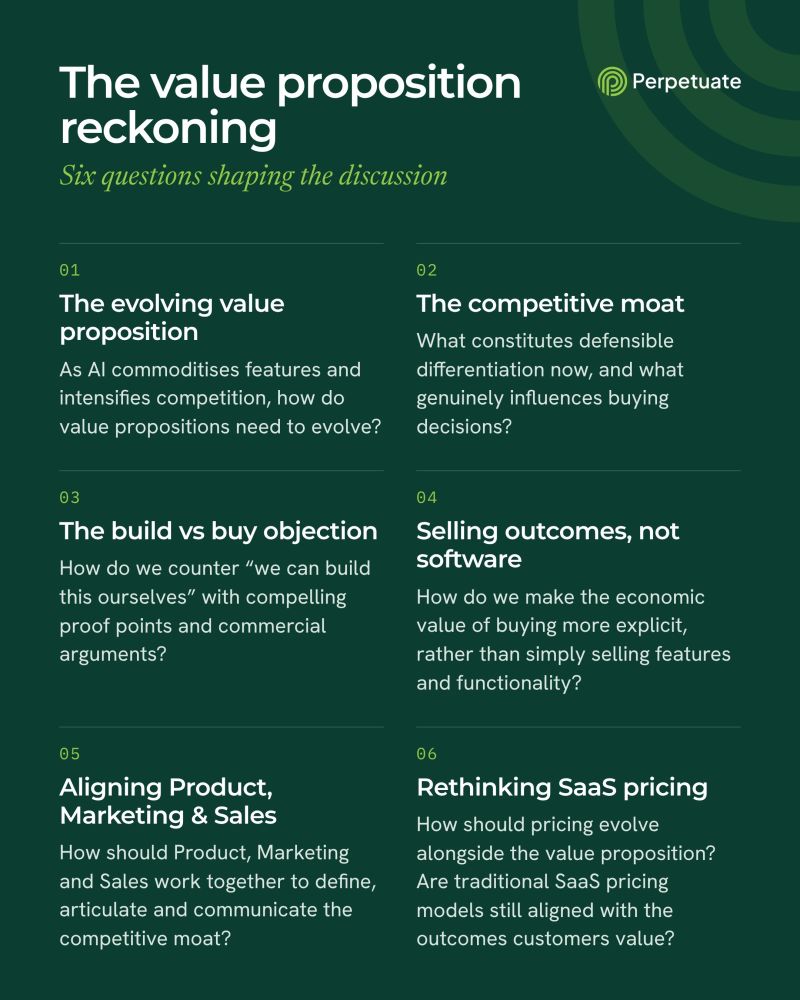
Slide titled "The value proposition reckoning: six questions shaping the discussion", listing the six questions put to CMOs in SaaS: the evolving value proposition, the competitive moat, the build vs buy objection, selling outcomes not software, aligning Product, Marketing and Sales, and rethinking SaaS pricing.

On Wednesday 28 October 2026 we held the CMOs in SaaS Forum: an online, invitation-only peer discussion for CMOs and VPs of Marketing at high-growth Australian B2B SaaS companies, with 12 to 15 in the room. Hosted by Sophia Philippou, it put one question to the group: how does SaaS defend its value in the AI era, when building software has never been easier?

Build vs buy is not new, but the equation is shifting

We opened with the Retool 2026 Build vs Buy Report. It found that 35% of respondents have replaced at least one SaaS tool with a custom build, and 78% expect to build more custom internal tools in 2026. Sophia stated the caveat in the room: the survey covered 817 builders, including Retool customers, in late 2025. Retool is a low-code platform, so it leans towards building, and the sample does not represent all enterprise buyers.

The trend is visible either way, and it sits alongside an economic climate focused on operating costs. Almost everyone in marketing, product and tech has had a CEO forward a LinkedIn post saying "we need to build this." The ability to build is increasing. Is the value of buying keeping pace?

The six questions put to the room

  1. The evolving value proposition: as AI commoditises features and intensifies competition, how do value propositions need to evolve?
  2. The competitive moat: what is defensible differentiation now, and what genuinely influences buying decisions? Switching costs, network effects, scale economies and data effects were the reference point.
  3. The build vs buy objection: how do we counter "we can build this ourselves" with proof points and commercial arguments?
  4. Selling outcomes, not software: how do we make the economic value of buying explicit, rather than selling features and functionality?
  5. Aligning Product, Marketing and Sales: how should the three work together to define, articulate and communicate the moat?
  6. Rethinking SaaS pricing: are traditional pricing models still aligned with the outcomes customers value?

What came out of the discussion

  • The true cost of building is still underestimated. It is not just the initial development cost. It is the ongoing maintenance, security, integrations, specialist talent and the opportunity cost of diverting resources from the core business.
  • Domain expertise and collective intelligence are becoming moats. AI can help replicate functionality. Replicating years of accumulated industry knowledge, proprietary data, benchmarking and deeply embedded workflows is a very different proposition.
  • Not every customer is your ideal customer. Be much sharper on ICP, the ideal customer profile. If a buyer does not value your domain expertise, differentiation or outcomes, are they the customer to win?
  • Sell outcomes, not software. SaaS has always been tied to productivity, efficiency and work that would otherwise need more people or processes, and AI potentially supercharges that. Are value propositions, commercial narratives and pricing models evolving fast enough?
  • Product, Marketing and Sales need to be closer than ever. The challenge is no longer what can be built, but what customers need, value and will pay for.
Perhaps the competitive advantage in SaaS isn't who can build the most, but who understands their customers deeply enough to know what is worth building.

Sophia Philippou, Partner, Perpetuate

We have seen this movie before

The Gartner Hype Cycle was the room's reminder that this pattern has a history. Gartner's 2025 research placed generative AI moving into the Trough of Disillusionment, and its 2026 AI research says investment remains strong while realising business value is uneven.

In my calls with marketing and product leaders around the forum, the value story keeps moving past features and into deterministic versus probabilistic AI, human in the loop, the data and intelligence pooled from it, uptime, cost and trust.


Sophia's original post is on LinkedIn. For a related read on how AI is reshaping team design, see the Product Leaders Growth Forum write-up. If you lead marketing at a software company and would like to join a future forum, message Sophia on LinkedIn →

Sophia Philippou is a Partner at Perpetuate, leads its SaaS Marketing and Product practices, and hosts the Perpetuate Growth Series.